



welcome to the
INTERACTIVE GARDEN
Located in the inner yard of Klaipeda pedagogical psychological service
Working hours: 8:00 - 17:00 Monday to Friday
For the assistance: administration is in the 2nd floor. Call: +370 699 10201
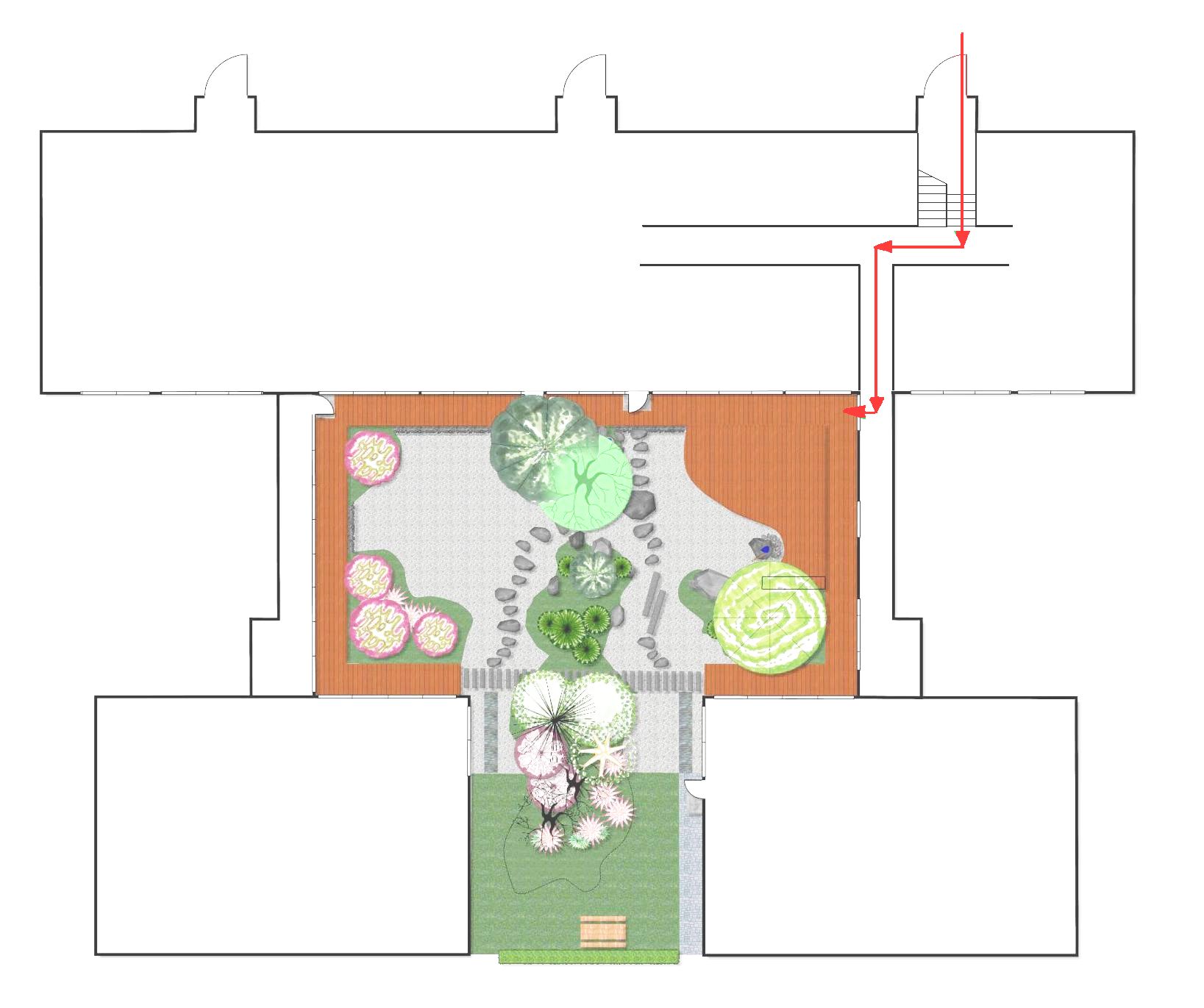
⇐ Entrance: through 1rst floor coridor.
Take a Virtual Tour of our Garden
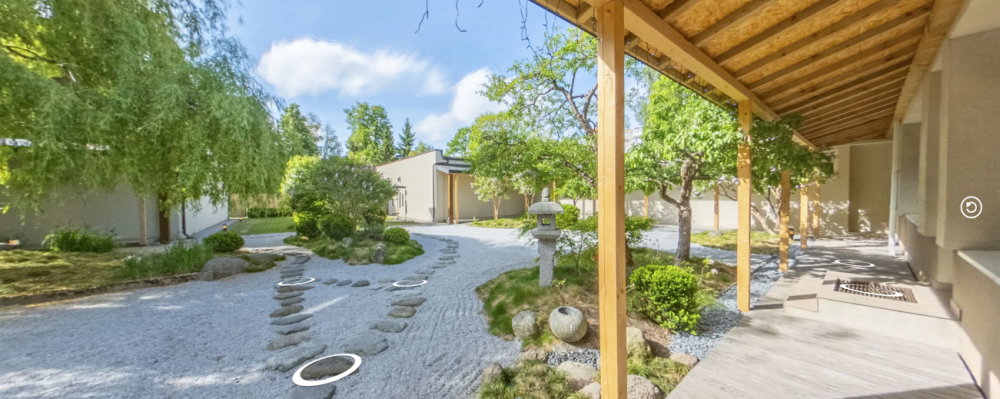
 3D virtual tour - Press a link
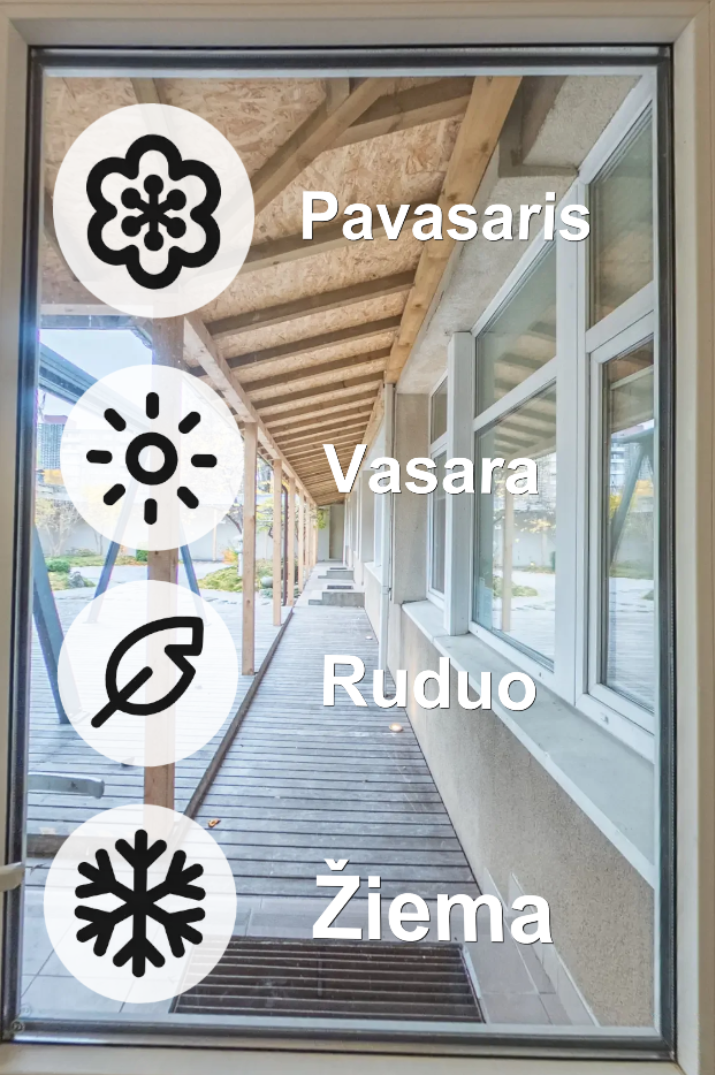 Virtual tour instructions
Clicking on the link will open the initial view of the virtual tour (the facade of our office building). Please enter through the door and follow the arrows to the door of the inner garden. On the door you will see a choice of the season (Pavasaris - Spring, Vasara - Summer, Ruduo - Autumn, Žiema - Winter). After choosing the time of year you like, you can visit the garden.
While visiting the garden, if you want to change the time of year, press the "Refresh" button ↵ (it is on the right side of the screen).
If you want to return to the website, press "back" ← in your browser.
Garden creators
Garden project - Laura Popkytė - Fukumoto
Garden setup and maintenance - UAB Bangos Landscaping
PLANT DESCRIPTIONS
Contents
TREES:
1. Weeping willow, Latin: Salix babilonica.
2. Yellow plum, Latin name Prunus domestica var.syriaca (fruit tree)
3. Antaninė apple tree, Latin: Malus (fruit tree)
4. Yoshino cherry, Latin name Prunus yedoensis (ornamental cherry)
5. Common lilac, Latin name Syringa vulgaris.
6. Hungarian lilac, Latin name Syringa josikaea.
7. Black pine, Latin name Pinus nigra.
8. Japanese maples, Latin name Acer palmatum.
9. Siebold's apple tree, Latin: Malus sieboldii
10. Lily-flowered magnolia 'Nigra', Latin: Magnolia liliiflora 'Nigra'
11. Mountain pine, Latin: Pinus mugo.
SHRUBS.
12. Intermediate Yew, Latin: Taxus x media 'Hillii'
13. Azalea, Latin name: Azalea 'Cannon's Double'
14. Large-leaved hydrangea, Latin name: Hydrangea macrophylla ‘Endless Summer’
15. Rhododendron, Latin: Rhododendron.
GROUND COVER PLANTS:
16. Giant Hakone grass, Latin name: Hakonechloa macra.
17. Narrow-leaved fescue, Latin: Festuca gautieri
18. Japanese Lily-of-the-Valley, Latin: Ophiopogon japonicus.
TREES:
Weeping willow, Latin: Salix babilonica
The weeping willow (Salix babylonica) is a tree of the Salicaceae family. Native to northern China, it has long been spread throughout Asia and Europe along ancient trade routes.
It grows to a height of 10-12 m. Its branches are thin, long, drooping, often almost reaching the ground. The leaves are linear, finely toothed, 9-16 cm long and 1-2.5 cm wide.
The racemes are up to 2.5 cm long, drooping, and grow as the leaves unfold. It blooms in April-May.
A decorative, honey-bearing plant. Young leaves, twigs, and shoots are used in folk medicine.
Rarely grown in parks in Lithuania, it is a popular decorative plant in residential neighborhoods of large cities, where specimens half a century old can be found. Although highly decorative in cities, this tree requires special care. Due to its heavy, dense crown and fairly soft wood, the branches of mature specimens often cannot withstand strong winds. Breaking branches can injure people and damage property, and the tree often breaks at the trunk. Therefore, pruning of thick side branches is recommended. This species tolerates pruning very well. Like other willows, the weeping willow sprouts and grows back after being cut down, forming a new large crown within a few years.
All individuals of the weeping willow in Europe are female, so they do not produce seeds. Weeping willows are usually propagated vegetatively – a branch stuck into moist substrate quickly takes root.
Yellow plum, Latin name Prunus domestica var.syriaca (fruit tree)
This is a fruit tree of the Rosaceae family, a subspecies of the domestic plum (Prunus domestica). It originated in the Middle East. It is often a small tree or a large shrub. It is characterized by small, bright yellow fruits ("plums"). They ripen from July to mid-September. It bears fruit very abundantly. The flesh of the fruit is soft, juicy, and sweet. Plums are mainly used to make compotes, jams, and cakes, and in some parts of Europe, they are used to make brandy (Eau de vie). The Lorraine region in France is particularly famous for growing yellow plums. In Lithuania, yellow plums are often grown in collective gardens, farmsteads, and roadsides. In this orchard, the plum trees are trained using the niwaki technique, i.e., their crowns are pruned in the Japanese style.
Antaninė apple tree, Latin: Malus (fruit tree)
The fruit is medium-sized, slightly elongated, spherical in shape. The skin is smooth, shiny, yellowish-green, and light yellow when ripe. The apples are juicy, sour, with a strong aroma and high pectin content. When stored properly, the harvest lasts until November. The tree begins to bear fruit in 2-3 years, and the fruit is picked in mid-September.
Fruit tree: fully grown plant is about 3 meters wide and 3.5 meters tall.
Characteristics: the variety is resistant to frost and disease, partially self-pollinating
Yoshino cherry, Latin name Prunus yedoensis (ornamental cherry)
The flowers are pink, double, single flowers 6 cm wide, gathered in dense inflorescences, blooming profusely in April before the leaves burst or at the same time. The flowers are fragrant, inflorescences of 3-6 flowers ranging from white to pink shades.
Common lilac, Latin name Syringa vulgaris
Common lilacs are very popular ornamental plants, most often planted in Lithuania in farmsteads, near houses, and less often in parks and on roadsides. The fragrant inflorescences are picked and used as flowers. Many ornamental varieties have been bred. At the end of summer, the plant may be attacked by powdery mildew. It is recommended to prune faded inflorescences immediately after flowering, so that the tree will bloom more profusely the following year.
It is a deciduous shrub of the Oleaceae family. It grows naturally on the mountain slopes of the Balkan Peninsula, but has been cultivated throughout most of Europe since ancient times.
It is a deciduous shrub or small tree that grows up to 6-7 m in height. The trunk diameter is up to 20 cm. The plant produces many vigorous shoots from the roots. The trunk is short, often crooked and branched. The bark is gray or grayish brown, smooth on young trees, cracked and peeling on older ones. The leaves are simple, with smooth edges, heart-shaped, 4-12 cm long, 3-8 cm wide, dark green on top, and do not turn yellow in autumn. The flowers are very fragrant, lilac, white, bluish, pinkish in color, clustered in panicles (8-18 cm long). The flowers are 5-8 mm in diameter and have four petals. The fruit is a dry, smooth seed pod 1-2 cm long. When dry, it splits into two parts and scatters winged seeds.
Hungarian lilac, Latin name Syringa josikaea
Hungarian lilacs are beautiful and fragrant, blooming in long clusters of flowers about two weeks later than common lilacs. This lilac tolerates both drought and waterlogging. Hungarian lilacs, as the name suggests, grow naturally in Hungary, Romania, and western Ukraine. It is a 3-4 m tall shrub with strong, upright branches. Annual growth is about 35 cm. The leaves are elliptical, dark green, with a bluish-green underside. It blooms in June (two weeks later than S. vulgaris) with reddish-purple flowers that are clustered in narrow, long clusters up to 15 cm long. The flowers have a very strong scent. Grows well in fertile, loose soil in a sunny location. Hungarian oleanders tolerate excess moisture as well as drought. They are resistant to frost.
Black pine, Latin name Pinus nigra
Black pine is the most popular species of pine in Lithuania. This species is naturally widespread in southern Europe. Compared to other pine varieties, this variety is newer in Lithuania, which makes it more attractive to many. Black pine stands out with its dark green needles, which give the plant elegance, splendor, and luxury.
Black pine grows quite quickly (about 30-70 cm per year) and can reach a height of over 20 meters. So, if you want the pine tree in your yard to grow faster, we recommend choosing a black pine.
The crown of the black pine is conical and spherical, and as the tree ages, it takes on an umbrella shape. The needles of this species are stiff, dark green in color, and approximately 8-15 cm long.
Black pine is shaped in the garden by giving it a lower growth rate by shortening the annual shoots.
Japanese maples, Latin name Acer palmatum
Native to Japan, China, Korea, and Eastern Mongolia. It has been cultivated in Europe since the early 19th century. More than 1,000 forms and cultivars of this species have been discovered and cultivated. An ornamental tree or shrub, also known as the Japanese maple. The leaves are palmate, 4-12 cm long, five-lobed, more often seven-lobed (sometimes nine-lobed), narrow, greenish-red, depending on the season, red and orange in autumn. Suitable for gardens, parks, bonsai, rock gardens, and Japanese gardens.
Siebold's apple tree, Latin: Malus sieboldii
Siebold's apple tree (Malus toringo) is native to Korea and Japan. It is a tree or shrub 4–10 m tall. The twigs are brown with a purplish tint, sometimes thorny. It blooms in May with pale pink flowers about 2 cm in diameter, clustered in sparse inflorescences. The fruits are 6–8 mm in diameter, usually greenish-yellow. These small, berry-like apples really liven up a hedge. They are resistant to winter frosts and prefer sandy loam and loamy soils.
Lily-flowered magnolia 'Nigra', Latin: Magnolia liliiflora 'Nigra'
A small shrub or small tree with branches that branch out from the base. It grows up to 4 m tall. This is one of the most ornamental magnolia varieties, with a wonderful fragrance, often blooming repeatedly in late summer. The leaves are large, green, and glossy. The flowers are large, fragrant, and narrow tulip-shaped, with burgundy-colored petals on the outer side and lighter or white on the inner side. Flower diameter up to 12 cm. Grows best in a sheltered location. Pruning is possible in midsummer after flowering. Planted in medium-sized plots as a solitary plant. It is recommended to mulch the roots to ensure adequate moisture and prevent freezing.
Mountain pine, Latin: Pinus mugo
It grows naturally in the mountains of Central and Eastern Europe: the Pyrenees, the Apennines, the Alps, the Ruda Mountains, the Tatra Mountains, and the Balkans. Depending on its geographical location, it grows at altitudes ranging from 200 to 2,700 meters or higher. In the early 9th century, Pinus mugo was introduced to southwestern Lithuania. It was planted on the Curonian Spit to stabilize the sand and halt the erosion of the dunes. Later, these pines began to be planted as ornamental plants around residential areas.
SHRUBS
Intermediate Yew, Latin: Taxus x media 'Hillii'
Suitable for hedges and as a specimen plant. A colonial-form variety of the intermediate yew, popular for hedge planting. It grows fairly slowly, reaching a height of 3–4 meters and a width of 60–80 cm. The needles are dark green. It grows best in fertile, moist soil. It thrives in partial or full shade. It tolerates pruning and shaping well. The plant is frost-hardy.
Azalea, Latin name: Azalea 'Cannon's Double'
The azalea is a plant in the rhododendron family. It grows to a height of 2 m and the same width over a period of 10 years. It blooms in May. It is cold-hardy.
Large-leaved hydrangea, Latin name: Hydrangea macrophylla ‘Endless Summer’
A perennial shrub reaching about 1.2 m in height, blooming with impressively large pink flowers. The flower clusters are umbrella-shaped panicles up to 30 cm in diameter. Flower buds form on the previous year’s shoots, so only the spent inflorescences should be pruned, while the stems must be preserved. Blooms from July to September, depending on weather conditions. They are not winter-hardy and may freeze, so they must be covered carefully. As cold weather approaches, it is recommended to cover the roots with peat and the branches with a double layer of plastic mulch. They can be grown in pots or tubs and stored in a basement over winter. They love moisture. Grow in shade or partial shade. Plant in neutral or slightly acidic, moderately fertile or fertile soil. These hydrangeas are particularly sensitive to spring frosts—if the buds freeze, they will not bloom that year. They should only be uncovered after the spring frosts have passed; the most important thing is not to rush to uncover them.
Rhododendron, Latin: Rhododendron
Rhododendron is a genus of flowering shrubs in the heath family (Ericaceae). There are about 1,000 species worldwide. In Nepal, the rhododendron is the national flower. Rhododendrons have always been and remain a garden ornament. These evergreen shrubs charm not only with their colorful flowers but also with their dense, lush foliage, which adorns the garden all year round.
GROUND COVER PLANTS:
Giant Hakone grass, Latin name: Hakonechloa macra
This Japanese forest grass is prized for the graceful appearance of its long, narrow, drooping leaves. It is a long-lived ornamental grass. In spring, Hakone forms a low clump; its leaves are green at first, turn reddish in summer, and take on coppery-orange hues in autumn as the weather cools. It makes a wonderful color accent in shady spots. The leaves swaying in the breeze add movement to the flower bed. The flowers are small, inconspicuous, and not particularly decorative, barely visible among the leaves. It grows fairly slowly, so there is no need to repot it often, but over time it forms a beautiful shrub suitable for borders and edging; it looks wonderful when planted in groups. It pairs beautifully with other shade-loving plants. It is undemanding, but it may take some time to establish itself initially.
Narrow-leaved fescue, Latin: Festuca gautieri
It forms a cushion of green, twisted, needle-like, bright leaves. In late spring to early summer, it is adorned with upright, yellowish-green spikes above the clump. Faded spikes should be cut back in late summer. A wonderful groundcover plant for mass plantings, borders, or rock gardens. A fast-growing grass.
Japanese Lily-of-the-Valley, Latin: Ophiopogon japonicus
The dwarf variety of Japanese Lily-of-the-Valley is native to East Asia (Japan, Korea, China). When mature, it reaches a height of no more than 15 cm (usually up to 10 cm) and is related to the lily family. It blooms from late August to October, producing new leaves annually from the center of the clump. It is undemanding regarding soil and moisture. After flowering, blue berries appear, which contrast beautifully with the fresh green leaves. The leaves remain evergreen throughout the winter. Over several years, it forms a dense, carpet-like surface; it is recommended to plant 10–12 plants per square meter. It is hardy to Zone 6B (-20°C) and is primarily suited for cultivation in western and central Lithuania.
Irises, Latin: Iris
Irises, or as people commonly call them, have flowers with interesting shapes and vibrant colors. The famous Greek philosopher Hippocrates named irises after Iris, the goddess of the rainbow, because their flowers come in a range of colors—from white to nearly black. They can be speckled, spotted, or striped. The early varieties bloom first, followed by the hybrid bearded and Siberian irises. Most varieties bloom in late May and early June. Since each flower blooms for only a couple of days, it is recommended to plant irises in groups.
Japanes garden symbols
In the inner backyard of the premises there has been formed a calm and aesthetically pleasing space for various therapeutic activities, educational events, classes with children, meetings with parents, support specialists and educators. The landscape design was developed by architect Laura Fukumoto.
The garden is designed to harmonise the environment and to emphasise the connection between man and nature, which ' . is so important for human health and inner peace.
The idea of the Japanese Garden
Karesansui - dry landscape type gardens that use no water to express images of oceans, rivers, lakes, waterfalls and their surrounding mountains and rocky shores.
The theme chosen for this Karesansui type garden is the Curonian lagoon. The water is expressed in the form of a stone rubble depicting the waves of the lagoon calmly crashing against the shore, washing the shores of the Crane, Turtle and other islands. ; The Willow tree swaying on Crane Island captures the aquatic nature of the landscape. The seating area underneath invites the visitor to sit quietly in the Shade of the tree, listen to the rustling of the leaves and the dripping of water from the nearby Chiozubachi Stone Bowl. And the seagulls flying over the garden provide an additional sense of sound and a feeling as if the lagoon, in the form of stone rubble, were calmly washing up on the shore.
Other islands in the garden preserve plants from the old area (Caucasian plum, apple, lilac, hawthorn, mountain pine). Their annual shaping will give the garden a green openwork coverage.
Further on, the borders of the building are flanked by a terraced boardwalk, allowing the garden to be walked around and observed from all sides. The space at the rear of the garden is dedicated to canitherapy (dog therapy). The lawn in that part of the garden provides an opportunity not only for therapy sessions for children with the dog, but also for walking barefoot on the lawn.
Japanese garden elements
Water. Water is represented by a stone rubble.
The Oribe-style Stone Lamp (sculptor Andrius Sasnauskas) has a hieroglyphic symbol expressing protection on the front and, on the back side, snakes from Lithuanian folk mythology representing protection on the other side. In the garden, the lamp indicates the direction of the road, as if it were a landmark in the path of each individual.
The Chiozubachi and Tsukuba stone water bowls (sculptor A. Sasnauskas) are intended for the purification of body and soul. Their ori gin is linked to the tea ceremony in Japan. After using a bamboo scoop to get water, one should first use it to pour it over the left and then the right palm of the hand, and then, after wetting the mouth with the water in the scoop, to pour it over the shaft of the scoop itself. This prepares a clean scoop for the next visitor to the garden. This cleansing of one's insides allows one to enjoy the garden with a lighter mind, as the ritual brings mystery and peace. During the action, one's thoughts are transferred to the garden surrounding, leaving behind one's everyday worries.
Turtle and Crane islands. The garden composition includes the Turtle Island. The stone at the front of the island represents the turtle's head and. the sides represent the turtle's legs. In the island next to the Willow tree, a grouping of stones can be seen with a crane composition. Since ancient times, the turtle and the crane have been regarded as symbols of longevity in Japanese mythology, and it is believed that the crane can live for 1 000 years and the turtle - for 10 000 years.
Pathways. The pathway that leads from the office to the therapeutic space (at the end of the garden) symbolises the path of inner relief, which takes one from the everyday material life to the spiritual life - from a state of difficulty to a state of relief.
Bamboo is an integral element of Japanese gardens. It is used for garden fencing, borders, outdoor lighting, water bowls, etc. Bamboo is considered a symbol of prosperity in Japan because of its strong root system. It also symbolises longevity, health, fertility, strength, flexibility, resilience and optimism.
Plants. The following plants are used in the Japanese garden to reveal the changing of the seasons: in spring - plum, apple, sakura, rhododendron, azalea, magnolia, then - hawthorn, lilacs in the late spring/early summer, hand maple - in the autumn season, and the pine and yew trees - in the winter for their green strength.
The outdoor musical instrument DO. If you ask a Lithuanian what he thinks of "when he hears the word "do", the most common answer is that it is the name of a note (sound). What if you ask a Japanese? He or she would say - the road. A path of sound, a. path in sound. These meanings sound very nicely together, as does the outdoor musical instrument that Linas Švirinas and Rytis Zinkevičius created for the garden. That's why we gave the name DO to the outdoor musical instrument.
We hope that the sounds of DO will allow us to experience or enhance the charm of the moment, to encourage us to take in all that is beautified and surrounds the garden as a whole, to merge with it, and to feel once again that there is nothing else but the PRESENT.

