


INTERACTIVE GARDENS
News
2026-05-15

Activity & Progress Review November 2023 – February 2026
Activity & Progress Review November 2023 – February 2026
2025-11-26
The Power of Nature in Shaping Cities: How Green Spaces Are Becoming a New Standard of Regional Well-Being
As green infrastructure expands across Europe, regions are increasingly recognising nature as a source of public health, learning, and community connection. The Interactive Gardens project brings this vision to life at the regional level, uniting diverse organisations in a shared dialogue about the types of green spaces people genuinely need today.
The project meeting held in Klaipėda brought together three distinct partners: the Klaipėda Pedagogical Psychological Service, the Biržai District Municipality, and the Aukštaitija Protected Areas Directorate (Biržai Regional Park). Each contributed unique experiences and perspectives on the role of nature within public spaces.
Seeing Nature Through Different Lenses
The Klaipėda University Botanical Garden, which served as the starting point of the meeting, illustrated that plant diversity can be far more than an aesthetic feature. It can become a cognitive, educational, and research-driven resource—an archive of knowledge revealed through interactive learning experiences.
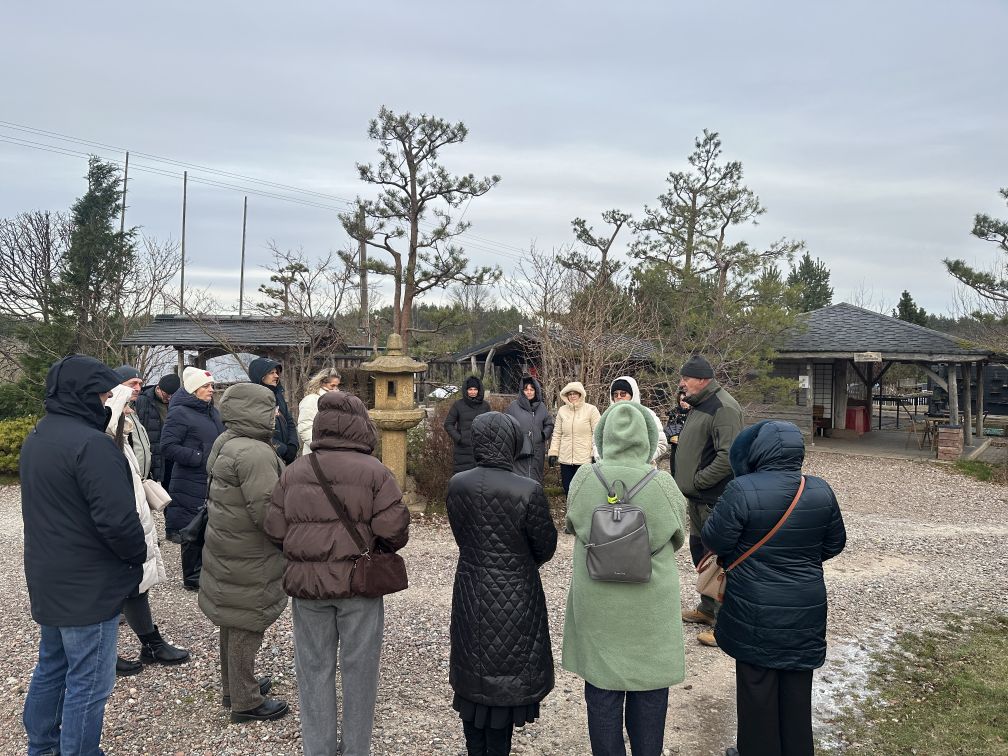
A visit to the Japanese Garden in Kretinga District added yet another layer of insight. Culturally grounded green spaces function not only as landscape elements but also as symbolic experiences. Here, nature becomes heritage, story, meditation, and artistic expression.
The experience shared by the project partner Klaipėda Pedagogical Psychological Service revealed nature’s emotional dimension. Their carefully designed Oriental-style courtyard shows how even a small, thoughtfully shaped space can support emotional well-being. Research conducted on site confirmed that the community embraced the space warmly: visitors reported a stronger connection to nature, a sense of calm, improved mood, new skills, deeper knowledge of biodiversity, and an appreciation for the garden as a unique aesthetic and soothing experience.
Nature as a Designer of Well-Being: a New Approach and New Spaces in Birzai
Biržai currently offers the clearest example of how a new paradigm of health-supportive environments is taking shape in regional contexts.
The Biržai District Municipality presented plans for a quiet therapeutic space in Dauguvietis Park, adjacent to the local hospital. This is not a decorative undertaking, but a carefully considered effort to integrate aromatherapy plants, tactile greenery, and tranquil walking paths into a healing setting. The space is designed to support not only patients but also healthcare workers and visitors.
The Aukštaitija Protected Areas Directorate, responsible for Biržai Regional Park, introduced the development of a new educational trail along the shores of Lake Širvėna and the Lilac Peninsula. Here, the emphasis shifts to active engagement with nature—movement, observation, exploration. This area is envisioned as a place where the community can not only rest but also participate in nature education, guided walks, events, and well-being activities.
Together, these initiatives show that in Biržai, nature is increasingly understood as an architect of well-being—not a passive backdrop, but an active shaper of human experience.
A Shared Vision: Nature as Experience, Not Decoration
Although the project partners represent diverse fields—from education and emotional health to municipal governance and protected areas management—their work reveals a common trajectory. Green spaces are being designed not as ornamental plantings but as experiential landscapes that nurture well-being, foster learning, and strengthen community ties.
Today, the familiar question “What should we plant here?” is becoming less central. In its place emerges a more meaningful query:
“What will people be able to experience, understand, and discover here?”
This shift marks the new standard for green infrastructure.
Project #C036 “Integrated System for Developing Interactive Public Gardens in the Baltic Sea Region” (INTERACTIVE GARDENS) funding from 2021–2027 Interreg Baltic Sea Region Programme for international cooperation.
For more information, visit: www.interreg-baltic.com
2025-11-14
International conference in Zemgale outlines the future of "smart gardens"
What will public green spaces look like in the future, what technologies will be used to manage them, and can gardens become part of healthcare? Answers to these questions were sought by invited industry experts and project partners from Latvia, Lithuania, Estonia, Finland, and Denmark, who gathered at an international conference in Koknese on September 17 and 18. The event was organized by the Zemgale Planning Region within the framework of the Interreg Baltic Sea Region program project "Integrated System for Interactive Public Garden Development" (Interactive Gardens).
The conference convincingly demonstrated that a modern garden is no longer just an aesthetic recreational spot, but a multifunctional ecosystem where the latest technologies, science, and a deep understanding of human needs come together. A prime example of Latvian innovation was the "smart garden" (iDārzs) from the Bulduri Technical School, which features an automated irrigation system, sensors, and even a robot that collects data on plant health, showcasing how technology can make park management more sustainable and resource-efficient.
Special attention at the event was devoted to the impact of green spaces on public health and well-being. Partners from Finland introduced their unique "Health Forest" model, where nature is integrated into the healthcare system – specially designed natural areas are located near medical facilities, and doctors can issue a "prescription" for a forest visit to promote recovery and improve mental health. The effectiveness of such an approach was confirmed with specific data by partners from Lithuania – in a survey conducted by the Klaipėda Pedagogical Psychological Service about their newly created Japanese garden, 100% of visitors confirmed that the visit had improved their mood. This dimension of well-being, which is particularly important for seniors, is complemented by the social aspect – the opportunity to meet and be together. The necessity for accessible and comfortable gathering places was emphasized at the conference by a representative of the Latvia Association of Senior Communities, who welcomed the goal of the Interactive Gardens project to create precisely such inclusive public outdoor spaces.
The experts' presentations covered a wide range of ideas – from landscape design philosophy to specific solutions for public outdoor spaces. Landscape architect Ludmila Knoka introduced the principles of the “New Wave” style, which encourages the creation of nature-friendly and sustainable “four-season gardens.” These are aesthetically pleasing even in winter, emphasizing plant structure rather than just flower color. The conference also provided an insight into good practices in other countries, such as Estonia's experience in transforming Vana-Kalamaja Street in Tallinn into a pedestrian-friendly area with community gardens, and the Danish model, where universities play a leading role in creating innovative educational gardens.
"This conference is a confirmation that we in the Baltic Sea Region are thinking in the same direction – how to create a higher quality, greener, and more people-oriented public space. By exchanging such diverse experiences, we gain not only inspiration but also practical tools that municipalities and industry professionals throughout the Baltic Sea Region can use in the development of their green areas. Our goal is for the ideas developed within the project to transform into real, tangible works that improve the daily lives and well-being of residents," emphasizes Sigita Šiļvjane, "Interactive Gardens" project manager at Zemgale Planning Region.
The project ideas are already being put into practice. For example, Lithuanian partners in Biržai are improving the hospital park by creating raised beds and installing wind chimes, while the Directorate of Aukštaitija Protected Areas is improving access to the nature reserve by building a new bridge and enriching the landscape with hundreds of new tree plantings. The project's lead partner, the Zemgale Planning Region, is also preparing for practical improvement works, which will take place next season.
About the project: The project No. C036 “Integrated system for interactive public garden development in the Baltic Sea Region” (“Interactive Gardens”) is implemented with the support of the Interreg Baltic Sea Region Programme 2021-2027. The total funding of the project is €2,790,120 (including ERDF co-financing of €2,232,096). More about the project: https://interreg-baltic.eu/project/interactive-gardens/
This publication was produced with the financial support of the European Union. Its contents are the sole responsibility of Zemgale Planning Region and do not necessarily reflect the views of the European Union.
2024-09-25
Exchange visits on gardening for different community needs end with inspiration
The Baltic Sea Region Programme project “Interactive Gardens” has completed its phase with experience exchange visits. In joint meetings, project representatives shared the partners’ experiences and generated new ideas for creating gardens and activities accessible to the public. After the meeting in Zemgale in May this year, project meetings were organised in the other partner countries – Denmark, Finland, Estonia and Lithuania.
In Denmark, project participants got to know Aarhus University’s cooperation with an open-air museum, showing vegetable varieties and environmentally friendly growing techniques to different groups of society. Both practical work and research for students and pupils take place here, as well as an opportunity for people from local communities to meet and work together.
Colleagues from Finland presented the principles of creating a therapeutic garden, planning and the involvement of residents in its creation. The project participants visited the Elonkierto nature park, which was created in close cooperation between the Institute of Natural Resources, local governments, entrepreneurs and communities. On the nature trail, visitors can learn how to carefully use nature’s gifts – edible and medicinal wild plants. Next, the partners got to know the agricultural plants grown in Finland – observing them in nature, getting information from the stands located there, as well as tasting local products, Awareness of the environment is promoted here by organising creative activities for both children and adults, using materials from Finnish nature and countryside.
Estonian colleagues shared their experience of introducing meadow plants into Tartu’s lawns, which need to be mowed less often to reduce noise and dust in the city. On hot summer days, such lawns provide more moisture and cool the air, making the environment more pleasant. In Rakvere, the transformation of a former gravel quarry into a beautiful, green space for sport, recreation and cultural events was demonstrated.
Lithuanian colleagues in Birži and their surroundings showed how to discover history, explain geological processes and preserve cooking traditions with the help of stories, visual materials and the involvement of visitors. Sinkholes, which are still forming, are a defining element of the Birži area and are still forming, for example, 49 new sinkholes have been registered this year. Although it is an everyday challenge for the residents of the Biržu district, to which they have to adapt, sinkholes are also an interesting tourist destination – for example, the Kirkili nature park and the observation tower have been one of the most popular attractions in Lithuania.
The purpose of the project is to develop gardens accessible to the public for maintaining health, getting the feeling of a garden and educating visitors both by using smart and innovative tools and by seeing and feeling the plants and environment in the surroundings more closely. The project partners will also take care of the exchange of information between neighboring countries, so that the various activities in the gardens are better known and easier to find. The project is managed and supervised by specialists from the Zemgale planning region. In the first year of the project, experience was exchanged between partners, and educational and health-promoting activities were organized in cooperation with non-governmental organizations. Garden planning, design, information preparation and virtual model development are mostly still ongoing.
ZPR is launching a new project with a focus on an interactive and accessible green environment
In order to create an interactive public garden system with innovative public garden services tailored to public health, well-being and education, the Zemgale Planning Region as the lead partner is launching a new Interreg Baltic Sea Region Programme project “Interactive Gardens”.
Last week, project partners from Latvia, Lithuania, Estonia, Finland and Denmark came to the National Botanic Garden of Latvia in Salaspils to get to know each other, discuss the way forward and officially launch the start of “Interactive Gardens”.
"The project will bring together science and research institutions, universities, municipalities and the planning region. Each partner has its own unique experience to share with others. For example, Vidzeme University of Applied Sciences will develop a virtual garden model, partners from Klaipeda have experience of using Japanese gardens in therapy, Aarhus University (Denmark), the Natural Resources Institute (Finland) and the Institute of Horticulture (Latvia) will share their research experiences and opportunities. Several gardens in Zemgale will become more attractive and interactive for visitors," Sigita Šiļvjane, project manager of the Zemgale planning region, comments on the contribution of partners to the project.
The main objective of the project is to develop an interactive nature garden concept, taking into account social needs and the diversity of local areas. The project results are intended for public, research and educational institutions, community groups using public garden services, stakeholders and their communities, as well as for the strengthening of EU strategies and policies of the Baltic Sea region.
The project aims to develop an interactive public gardens system that will provide information on how to plan and develop improvements. It will provide feedback opportunities in public gardens through remote and virtual visualisation (virtual model garden) and live experience (real demonstration garden). The virtual demonstration garden will include both visualisation of garden elements and environmental processes. Its initial aim is to convey information in an easily understandable manner in order to facilitate the planning of garden improvements and communication between public authorities and community groups. Demonstration gardens will help to explore public needs and offer supportive garden services to a wider audience.
Daina Feldmane, the leading researcher of the Institute of Horticulture, emphasizes that the project should result in a stronger core of gardens in the Baltic States, which would naturally continue to expand even after the end of the project: "With the help of the project, we will be able to expand cooperation networks, become more popular and accessible. We will strengthen the gardens available to the public, the cooperation between them, their users and creators. By using modern technologies, such as virtual and digital tools, we will also become more interesting for the younger generation, because young people perceive information differently." Daina Feldmane also says that the Institute of Horticulture plans to further improve and modernise the Institute's garden in order to better disseminate the gained knowledge. A well-maintained and strengthened garden of the institute will also help in future activities such as conducting research in areas such as environmentally friendly cultivation techniques, historical varieties and smart technologies.
Project no. C036 " Integrated system for interactive public garden development in Baltic Sea Region" or "Interactive gardens" is implemented in the Interreg Baltic Sea region program 2021-2027. The total funding of the project is 2,790,120, incl. ERDF co-financing 2,232,096 euros.
www.interreg-baltic.eu / www.europa.eu

